
Fleet · Autonomous · Depot · Payments
Charging that keeps every route on schedule
Charger, vehicle, and payment management for human-driven and autonomous fleets, with ChargeAI deciding when and how fast each vehicle charges

- Energy managed every month
- 10+ GWh
- Commercial sites live
- 800+
- Charger make/models on platform
- 100+
Autonomous fleets
Robotaxis never clock out. Neither does the depot behind them.
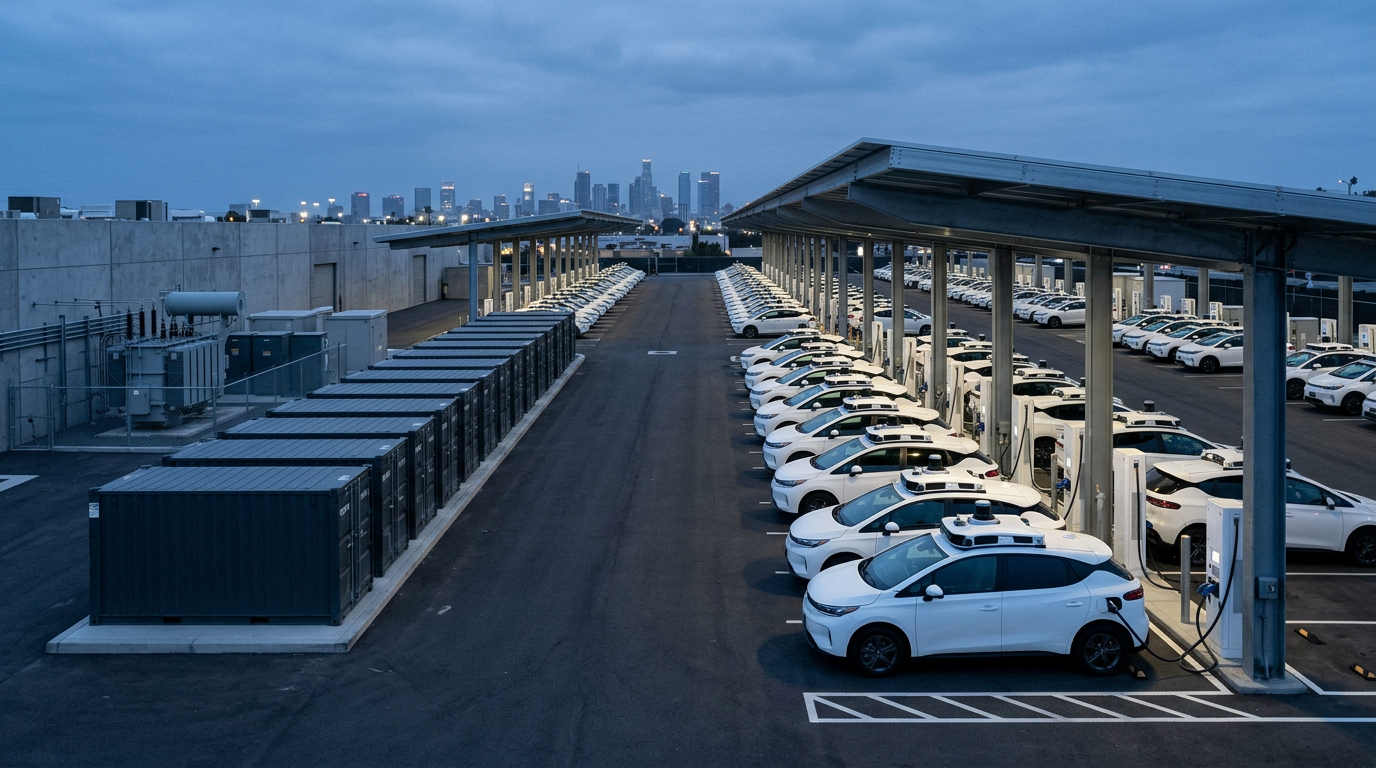
Synop connects your dispatch plan to the grid. One optimizer decides when every vehicle charges, what the energy costs, how solar and storage carry the peak, and how fast a new city depot can go live.
- Dispatch & charging
- Wholesale markets
- DER orchestration
- Speed to power
- Energy cost per mile vs. unmanaged
- −54%
- Site to first vehicles in service
- ~5 mo
- Vehicles per MW of existing service
- 2.3×
Dispatch meets the grid
Charge around the riders, and around the price.
There is no driver shift to plan around. An AV fleet’s charging window is whatever the ride demand forecast leaves open. Synop reads your dispatch plan and the day-ahead price curve together, pulling vehicles in during troughs and keeping them on the road through the evening spike.
- Depot charging
- Fleet in service
- Wholesale price
- 4–9pm peak
- Energy bought below $40/MWh
- 81%
- Charging during the 4–9pm peak
- 1.8%of daily kWh
- Vehicles at service SOC at shift start
- 312 / 312
Energy cost per mile
Four levers, one stack. Each one compounds the last.
Robotaxi unit economics live and die on cost per mile, and energy is one of the few line items you can move. Synop runs dispatch, wholesale optimization, on-site DER, and market enrollment as one optimizer, so the savings stack instead of competing.
- Unmanaged depot$0.120/miPlug in on return, retail tariff, demand charges on every peak
- Dispatch-aware charging−$0.020/miCharge to the next shift’s ride forecast, not to 100%
- Wholesale price optimization−$0.020/miShift energy into overnight and solar-hour price troughs
- DER orchestration−$0.015/miSolar and BESS shave demand peaks behind the meter
- Demand response revenue−$0.010/miIdle fleet and storage flex paid back by the grid
Speed to power
Launch the city on the service you have, not the one in the queue.
A new market launch should not wait four years on a service upgrade. Synop measures the headroom on an existing industrial site, firms it with storage, and paces charging so the first fleet goes live in months. When the upgrade lands, the same platform scales with it.
- Load study9 mo
- Design & permits12 mo
- Service upgrade build27 mo
- Headroom1 mo
- Chargers & BESS4 mo
- Fleet in service, scaling as the upgrade landsongoing
Vehicles on a 2 MW service
Same meter, same transformer. The difference is control.
Every Synop pillar, working for the same fleet.
- Fleet Charging
Dispatch-aware charging
Reads your fleet ops ride forecast and return times, then charges each vehicle to the SOC its next block needs. No over-charging, no stranded cars.
- Fleet Charging
Bay and charger orchestration
Assigns bays, sequences cleaning and sensor calibration around charging, and routes vehicles to available DCFC without a human in the loop.
- Energy Markets
Wholesale price optimization
Day-ahead and real-time LMPs feed the schedule directly, pulling energy into troughs and away from evening scarcity pricing.
- DER Orchestration
Solar and BESS on one controller
Storage shaves the demand peak when the fleet returns at once, solar covers midday top-ups, and the site islands through outages.
- Energy Markets
Demand response and capacity revenue
Parked vehicles and on-site storage enroll as flexible capacity, earning back during grid events without touching service levels.
- DER Orchestration
Speed to power for new cities
Headroom studies, BESS sizing, and managed load let a new depot run on existing service while the utility upgrade is built.
Uptime up, cost per mile down
ChargeAI scheduling
Re-plans automatically when a vehicle runs late, a route changes, or prices move — always solving for ready-by-departure-time first
Remote charger control
Start, stop, reboot, and set power limits across every depot. Schedule repeating, adaptive, and bidirectional sessions
Diagnostics in real time
Live OCPP logs, diagnostic reports, firmware updates, and O&M integrations so faults get fixed before they strand a vehicle
Vehicle readiness
Live SOC, range risk, and efficiency data via Zonar, Samsara, Motive, Geotab, or direct OEM integration
Payments & billing
Monetize depots and hubs, reimburse take-home charging, and accept cards, RFID, Payter terminals, or the Synop app
White-label driver app
Drivers find in-network chargers, reserve a connector, monitor sessions, and pay — all under your brand
Every charger, vehicle, and use case
- L2 AC
- DC fast
- Pantograph & induction
- Depots
- Public hubs
- Workplace
- Take-home
- Class 1–2
- Class 3–6
- Class 7–8
- Drayage
- Autonomous fleets
Questions
Which chargers does Synop support?
Synop is hardware-agnostic and supports 100+ charger make/models over OCPP, including L2, DC fast, pantograph, and induction. The Works with Synop program certifies interoperability.
How does charge management reduce cost?
ChargeAI shifts charging into low-cost windows, balances power across connectors to avoid demand charges, and integrates on-site solar and storage — without compromising readiness.
Can charging also earn revenue?
Yes. The same schedules that keep vehicles ready expose flexibility that Synop can enroll in demand response, curtailment, and V2G programs through Energy Markets.
How does Synop get our autonomous fleet dispatch plan?
Through an API integration with your fleet operations stack. Synop consumes ride demand forecasts, vehicle return estimates, and service SOC targets, and returns a charging schedule and bay assignments.
What happens if demand spikes unexpectedly?
Service always wins. Synop re-optimizes every few minutes and will release vehicles early, pause market participation, or draw on storage to keep the fleet on the road.
Do we need to own the depot energy assets?
No. Synop works with owned, leased, or third-party financed solar and storage, and with charging-as-a-service operators running the site on your behalf.
Book a demo
Make every depot route-ready
Bring your fleet schedule and charger list — we’ll show you projected uptime and cost per mile